Archive for the ‘Time’ Category

Because America Loves Dogs More than Europe

Thursday, February 9th, 2012

The covers of Time magazine this week:

Joe Klein Notices Newt Stole His Kid Janitor Idea

Friday, January 20th, 2012

Time columnist Joe Klein jumped to Newt Gingrich's defense (12/19/11) when the Republican presidential candidate floated the idea that poor school children should work as janitors at their schools. Klein's endorsement (FAIR Blog, 12/9/11) earned him a coveted P.U. Litzer Prize. But apparently there's more to it.

As Klein explains in this week's issue of Time (in an article that bears a title "Racial Slant Aside, Newt's Poverty Plan Could Work"), "When you strip away the racial appeals, though, Gingrich proposes some very creative ways to address poverty and dependency."

He added:

And yes, as Newt suggested, that last idea did come from me--although I put a slightly different twist on it.

I first made the suggestion in 1991, after the New York City janitors negotiated a gaudy contract that required them to mop the cafeteria floor only once a week.

The difference, apparently, is that Klein wanted to see "students and their parents help keep the schools clean," and "not just poor students--all students, even those attending the city's elite high schools. It was a form of public service, intended to build a sense of responsibility and community in students of every income level."

Well, at least Gingrich was going to pay the kids.

How about expanding the idea further, though: Why not let high school students take turns writing a column for a national news magazine? It'd be a nice form of public service. And consider the benefit to Time readers.

Time Cheers the Drone War

Tuesday, January 3rd, 2012

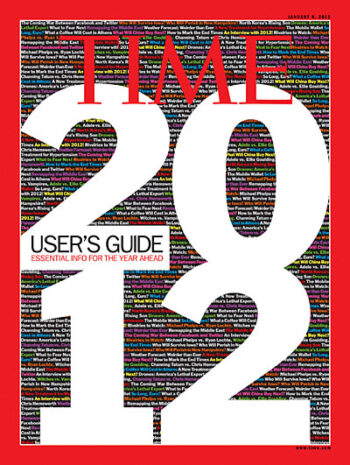
The new issue of  Time magazine promises on its cover "Essential Info for the Year Ahead." One apparently essential report: U.S. drones are awesome.

The report--written by Mark Thompson, available to subscribers only explains that a "hot military trend" this way:

Today's generals and admirals want weapons that are smaller, remote-controlled and bristling with intelligence. In short, more drones that can tightly target terrorists, deliver larger payloads and are some of the best spies the U.S. has ever produced, even if they occasionally get captured in Iran or crash on landing at secret bases.

And also, you know, kill innocent civilians.

There's no time to dwell on that, because there are too many good things to say about our remote-control war. "Drones had a big year in 2011," Thompson writes, and 2012 will be even bigger. As Time readers learn, "Unlike humans, these weapons don't need sleep."

And best of all, apparently, the military aren't the only ones doing the killing:

America's arsenal has become so small and lethal, you don't need the U.S. Army--or any military service at all, in fact--to field and wield them. The CIA, which used to be limited to derringers and exploding cigars, is now not very secretly flying drones. With little public acknowledgment and minimal congressional oversight, these clandestine warriors have killed some 2,000 people identified as terrorists lurking in shadows around the globe since 9/11.

The British Bureau of Investigative Journalism's investigation of the CIA drone program in Pakistan (8/10/11) stressed less of the gee-whiz and more the real-life consequences of the attacks. Estimates of civilian deaths range from 390 to 780-- including almost 200 children. U.S. officials, for the record, were once making absurd claims that no innocents were killed.

As for the apparent enthusiasm for waging a war where "you don't need the U.S. Army" at all--that is precisely one of the criticisms of the drone program; some legal experts argue that non-military personnel are not legal combatants, and therefore killing every one of those 2,000 "people identified as terrorists" was a war crime. Others point out that employing drones outside an active combat zone could also violate international law. But none of that is "Essential Info" for 2012.

Time Paints Paul Ryan as Deficit-Slashing Superhero

Thursday, December 15th, 2011

The fact that Time magazine named "The Protester" its Person of the Year was maybe a little surprising. Totally unsurprising, though, was the choice of a runners-up: Republican Rep. Paul Ryan, a hero to many in the corporate media for his bold calls to slash government spending on the poor.

It's hard to know where to start with reporter David Von Drehle's tribute. But let's try here:

Through a combination of hard work, good timing and possibly suicidal guts, the Wisconsin Republican managed to harness his party to a dramatic plan for dealing with America's rapidly rising public debt.

Dealing with the rising debt. Remember that idea.

He goes on:

The supply-sider from Janesville, Wis., tapped into a deep well of anxiety over trillion-dollar deficits at home and the threat of debt-fueled calamity in Europe. Did he deliver a perfect plan? Not even he claims that. But Ryan, 41, offered a budget that began to convey the scale of change necessary to defuse the American debt bomb: Sweeping tax reform. Unprecedented spending freezes. Most important, a thorough reinvention of federal entitlements.

Ryan's plan isn't perfect? And he admitted this?  What a guy! Ryan's heroic stance, readers learn, caused fury in both parties. Republicans were forced to make  difficult choices, while "Democrats howled at the sacrilege and Ryan's refusal to raise income tax rates on the wealthy."

Ryan's is a "tough budget"  that "brought President Obama down from his cloud of happy talk about windmills and high-speed trains to acknowledge that America has a plateful of peas to choke down after its binge at the dessert bar." That's right--massive cuts in social spending are good for you, just like eating your veggies.

The crux of the whole piece comes down to this:

Ryan's dramatic proposal would not have gained any traction if it did not address a widely acknowledged problem: Over the next two generations, the U.S. government is on track to spend many tens of trillions of dollars more than it plans to raise. Unless changes are made, that will force so much borrowing that interest payments alone will sink the federal budget.

Thankfully, Time tells us, Paul Ryan has "the courage to look the future in the eye. It is a seer's work to glimpse around the corner and sound an alarm."

The piece closes by noting that this brave bold plan "wouldn't balance the federal budget until 2040. The prophet of 2011 will be 70 years old."

Wait a second. I thought this was a bold deficit-reducing roadmap to deal with the debt?

The secret to the Ryan plan--the thing media don't talk about much--is that it doesn't do the thing they say they like about it-- namely, reduce the deficit. As Paul Krugman explained in the New York Times, the projected deficit in 2020 under the Ryan plan would be

about the same as the budget office's estimate of the 2020 deficit under the Obama administration's plans. That is, Mr. Ryan may speak about the deficit in apocalyptic terms, but even if you believe that his proposed spending cuts are feasible--which you shouldn't--the Roadmap wouldn't reduce the deficit. All it would do is cut benefits for the middle class while slashing taxes on the rich.

Or as James Horney of the Center on Budget & Policy Priorities wrote of Ryan (4/8/11):

Despite proposing $4.3 trillion in what would be the most severe and wrenching budget cuts in U.S. history--two-thirds of which would come from programs for people of low or moderate incomes--the plan barely reduces deficits at all over the next decade. That's because his budget cuts are offset by $4.2 trillion in tax cuts that would go disproportionately to those at the top. In essence, at least for the next decade, this plan is far less a blueprint for addressing deficits and far more a proposal to redistribute large amounts of resources from those at the bottom to those at the top.

Dean Baker writes that "Representative Ryan's program would imply a massive upward redistribution to the one percent." Maybe that explains why he's a Time runner-up. If "The Protester" is the Person of the Year, journalistic "balance" requires saying nice things about the One Percent.

Joe Klein: Newt's Kids-as-Janitors Plan Too Narrow

Friday, December 9th, 2011

We know by now that Newt Gingrich thinks he's smart. And we know there are plenty of people in the corporate media who believe the same thing.  How do they show their love for the brainy Republican presidential candidate? Time's Joe Klein shows the way in this week's issue (12/19/11) of the magazine. He doesn't think Gingrich should be president, but he does think Gingrich is full of interesting ideas.

Well, what about that plan to have kids work as janitors cleaning their schools? Klein's problem with it is that it doesn't go far enough:

I've known him for 25 years. I've had more creative policy conversations with him than with any other elected politician (with the possible exception of Bill Clinton). He is one Republican who is legitimately interested in improving the lives of the poor--although his ideas, which almost always involve market incentives, are quite different from the suffocating paternalism that many Democrats favored until Clinton came along. As early as 1990, Gingrich was paying poor children in Atlanta $2 for every book they read. He also proposed paying foreign-language-speaking students to tutor their English-speaking classmates in their native languages. He also proposed giving every literate child in the poorest neighborhoods a laptop. His recent idea of paying poor kids to help clean their schools--which has been the subject of a shrill, silly gust of liberal ire--is more of the same. It's a good idea, which would be much better if it were expanded to all public middle and high schools, with the work seen as an unpaid form of public service, a way to build community spirit and teach civic responsibility.

It calls to mind Paul Krugman's line about Gingrich--that he's "a stupid man's idea of what a smart person sounds like."

Zakaria and Democracy 'Tension'

Friday, December 2nd, 2011

In the new issue of Time (12/12/11), Fareed Zakaria writes in the first sentence of his column:

It is difficult to find a country on the planet that is more anti-American than Pakistan. In a Pew survey this year, only 12 percent of Pakistanis expressed a favorable view of the U.S.

It's not that difficult. The same survey of seven countries found one of them, Turkey, with an even lower 10 percent favorable opinion of the U.S., and Jordan just a hair above at 13 percent.

More important is Zakaria's conclusion:

There is a fundamental tension in U.S. policy toward Pakistan. We want a more democratic country, but we also want a government that can deliver cooperation on the ground. In practice, we always choose the latter, which means we cozy up to the military and overlook its destruction of democracy.

To be clear, he thinks siding with the military over democracy is a bad thing.

But he also thinks the United States "always" choose repression over democracy. This is notable, in that as of this summer he was writing that "all American presidents have supported and should support the spread of democracy." As we pointed out then, this does not square with the record.

And in March 2007, Zakaria wrote critically of the Bush record of intervening in Latin American countries, which he saw as a break with a Reaganesque policy of democracy promotion:

American foreign policy toward Latin America had been on the right track for two decades. Ronald Reagan orchestrated an extraordinary turnaround, supporting human rights, democracy and free trade in several countries.

As FAIR noted, this was a remarkable whitewash of the Reagan record.

And then there was the time Zakaria attempted to argue that U.S. policy towards Haiti was one long attempt to promote democracy:

Consider, for example, Haiti, where the United States has attempted to foster democracy on and off for almost a century--with almost no success. Why? Surely Haitians yearn to be free. But there are aspects of its politics, economics and culture that have made it very difficult to establish liberal democracy.

As FAIR pointed out, this period included U.S. military occupation along with support for a coup against Haiti's democratically elected government.

I suppose there's a chance that Zakaria's views towards U.S. power are becoming more critical. But if he's really reaching this conclusion, why talk about the "tension" between supporting democracy and working against democracy? Maybe he's just having trouble remembering which side of the argument he's on.

Time: Public Oddly Unfazed by Bongo Drums

Friday, October 14th, 2011

The new Time poll that found the public more favorably inclined towards Occupy Wall Street protesters than the Tea Party has been making the rounds. From the magazine's write-up of the poll:

A new Time/ABT SRBI poll finds 54 percent of Americans have a favorable view of the new protest movement, despite the images of bearded and shirtless youth playing bongo drums, rolling cigarettes and painting their bodies in Zuccotti Park.

Huh.  Perhaps when the public looks at a protest movement, it pays more attention to substance than the media, who are more focused on locating shirtless bongo players.

The Palin Campaign in Mark Halperin's Head

Monday, September 19th, 2011

Mark Halperin has a feature in Time magazine every week called "The Big Questions."

For a process-obsessed campaign reporter, this means a weekly who's up, who's down scorecard, in an easy to follow Q-&-A format.

This week's questions:

Is Sarah Palin in or out?

What could hold her back?

When does she have to decide?

Part of his answer to question one: "Palin remains more interesting to listen to than any other candidate."  Coming from a guy who once said, "I'm ready to cancel my vacation to go cover Rick Perry," maybe this isn't surprising. It is worth pointing out that Sarah Palin isn't, you know, a candidate for anything.

After praising her "maverick appeal" and "pox-on-both-parties, anti-Establishment message," Halperin notes that "as always, the media can't get enough of her."

Well, he's right about that.

Is the Election Over Yet?

Friday, September 16th, 2011

From Time magazine's Rick Perry cover story (9/26/11):

When you look at Perry, it's easy to picture him in an old Western. His late arrival in the primary field in August certainly felt like that moment when the big stranger steps through the swinging saloon doors and all heads pivot and the plinky-plunk piano dies away.

Wait-- there's more!

Moreover, Perry doesn't mind kicking over idols in the high church of conventional wisdom, a favorite Tea Party pastime. He's the one who calls Social Security a "monstrous lie," throwing in "Ponzi scheme" for good measure. Social Security is called the third rail of American politics, which is, of course, a reference to the electrified portion of a subway track. Touch it and you die. But there aren't any subways where Rick Perry comes from.

Zakaria, Libya and Iraq: Don't Remember What I Wrote

Friday, August 26th, 2011

Fareed Zakaria cheers the Libya War in Time magazine this week for not following the Iraq model:

It has been prosecuted with the memory of the Iraq war firmly in mind. Only this time the approach has been to view the last war as a negative example. The international coalition--and even the Libyan opposition--is doing pretty much the opposite of what was done in Iraq.

Zakaria explains that Obama "was clearly trying to avoid the mistakes of Iraq." Among the mistakes the Bush administration made:

Had UN weapons inspectors been given more time in the spring of 2003, the UN Security Council might well have endorsed the plan. Countries like India were seriously considering sending tens of thousands of peacekeeping troops, but only if there was a UN-blessed operation with a U.S. commander who also wore a UN hat (as was the case in Bosnia). But these were seen as petty, legalistic annoyances, and the operation felt like an American one from start to finish.

Zakaria can write these things because his message during the run-up to the Iraq War was, "Let the inspections do their work!"

Not exactly.

In the December 2, 2002 Newsweek, Zakaria warned that the inspectors weren't likely to find weapons because Iraq had gotten so good at hiding their WMDs:

Having gotten the inspectors back into Iraq with unfettered access, the Bush administration had better brace itself for the most likely outcome--they will find nothing. Don't get me wrong. Iraq is surely producing weapons of mass destruction. The United Nations and the United States have accumulated powerful evidence of this over the past decade, including testimony from Saddam Hussein's son-in-law, Hussein Kamal, about Iraq's biological weapons. But Iraq has become increasingly expert at dispersing and hiding these facilities, which are often small enough to fit into a bathroom or a van.

Zakaria explained that "the administration must force a crisis"--using the inspections as a way to force the war to begin:

Washington's hope is that in one of these many tests, Iraq will reveal that it is not cooperating and thus pave the way for military action. The inspectors will not find weapons but they might well find noncompliance.

Time is short. If events do not come to a head soon after December 8, the pressure for action will dissipate and the weather will make conflict impossible until next fall. And you cannot replay this movie.

A few weeks later (2/17/03), Zakaria was worried that the United States might lose face. He asked Newsweek readers to imagine what kind of world it would be if inspections were allowed to drag on just because some other countries demanded solid evidence:

But right now with Iraq, the need to maintain resolve seems obvious. Whatever one's initial views about taking on Iraq--and I have been for it--I cannot see how America can back down without damaging its, well, credibility.

Imagine the situation. A week from now, pressured by France, Germany and Russia, the United States decides to give the inspectors more time. It announces that, come to think of it, Saddam isn't that much of a threat. Though the president of the United States has said repeatedly that he would have "zero tolerance" for Iraqi deception, he didn't really mean it. When Colin Powell persuaded the United Nations to pass a resolution telling Saddam that he had a "final" opportunity to disarm or face "serious consequences," it was a bluff. (The "serious consequences" turn out to be that the United Nations sends in a few dozen more inspectors.) What would happen the next time the United States makes threats?

Luckily for people like Zakaria, damaged credibility isn't a concern for them. He'll still be considered an A-list foreign affairs pundit, no matter how wrong he's been about things that really matter.

Where Does Press Set Bar for Bachmann?

Friday, July 29th, 2011

Washington Post columnist Richard Cohen wrote a rather apoplectic column about presidential candidate Michele Bachmann this week, lamenting the fact that other GOP candidates aren't calling her out for being completely ill-prepared for the job:

Bachmann does not deserve to be in the presidential race. Legislatively, she has done little, she knows next to nothing and what she thinks she knows is wrong.

He also called her "an ignoramus" and "a bigot when it comes to gays."

Straight news coverage obviously isn't going to put things like that. But what's remarkable is how reporters seem to give Bachmann credit for being sort of, kind of, well-informed--at least relative to another political figure.

Here's Time magazine's recent take:

It is easy to dismiss Bachmann as a shorter Sarah Palin with a Minnesota accent. But there are important differences. Whereas Palin can stumble over simple questions, Bachmann is far surer on her feet. When Fox News host Chris Wallace recently recounted some of Bachmann's most outrageous statements and asked point-blank whether she is a "flake," the congresswoman didn't blink and delivered a firm recitation of her credentials. During a 2010 interview on MSNBC's Hardball, Bachmann stuck so resolutely to her talking points that the exasperated host, Chris Matthews, asked whether she was "hypnotized." She smiled and repeated them again.

"They'll throw nothing but heat at her, and she stays in the batter's box and doesn't flinch," marvels an adviser to a rival Republican candidate. Her fans say that's because Bachmann, who has two law degrees, offers more substance than Palin and can speak intelligently--and without Palin's mangled syntax--about policy issues. "She's smart. She's well informed," says Ralph Reed. It's true that Bachmann has a scant House record and a penchant for factual misstatements, including her bizarre claim that NATO air strikes killed up to 30,000 Libyans. But few other politicians so effectively combine policy, ideology--and pure star power.

Talk about exasperating.

The ability to recite talking points instead of answering questions can be called a lot of things-- being "sure on your feet" isn't one of them.

Bachmann has a "penchant for factual misstatements"--one example is given, sandwiched between tributes to her intelligence. Compare that to this assessment from early this year, courtesy of a PolitiFact editor:

"We have checked her 13 times, and [found] seven of her claims to be false and six have been found to be ridiculously false," PolitiFact editor Bill Adair told Minnesota Public Radio.

He added that no other politician had been factchecked as often as Bachmann without saying something that was found to be true.

"I don't know anyone else that we have checked more than a couple times that has never earned anything above a false," Adair said. "She is unusual in that regard that she has never gotten a rating higher than false."

That's pretty astounding--and doesn't really come through in the coverage of her campaign.

On top of all of this, of course, is the notion--rampant in the coverage of her campaign--that Bachmann should be compared to Sarah Palin. There's something strange--and deeply sexist--about this. But without a doubt, being compared to the most famously inarticulate national political figure of our era does a tremendous favor to Bachmann.

Richard Cohen is wondering when other Republican presidential candidate will criticize her record; the same question should be asked of the press corps.

Time: The U.S. Audience Is Different

Monday, July 25th, 2011

Every so often you're struck by something like this-- a collection of covers for this week's Time:

The Brave World of Boehner/Obama Bipartisanship

Friday, July 15th, 2011

Media love the "middle" in politics--where leaders of the two major parties come together to find common ground, renew the national spirit and/or live up to the ideals of the Founders. Time magazine (7/14/11) has a soppy piece about Barack Obama and Republican leader John Boehner's attempt to reach a budget deal.

Those efforts--some of which happened in secret--are, according to reporters Jay Newton-Small and Michael Scherer,

the story of two self-described dealmakers in a town where dealing is often a synonym for surrender, who ran up against the limits of their roles, their powers and their colleagues. Boehner and Obama have gotten credit for thinking big and working to overhaul outdated economic policies. But they waited too long to start, in part because they didn't take the time to get to know each other years ago. They also misjudged their armies: They rode out to rescue the country, only to watch many of their followers run for the hills.

They explain how the pair came up with the idea to use the debt ceiling as a lever for a budget deal in order to

freeze out their respective extremists and make the kind of historic deal that no one really thought possible anymore--bigger than when Reagan and Tip O'Neill overhauled the tax code in 1986 or when Bill Clinton and Newt Gingrich passed welfare reform a decade later.

You got it-- each side has its crazies that prevent great things from happening. Obama tried to freeze the left-wing extremists, and Boehner has.... well...I guess the upshot, according to Time, is unfortunately all the extremists balked; the left wouldn't cut Social Security benefits, the right wouldn't make wealthy people pay any more in taxes:

The Republican refusal to consider any new revenues, including making easy fixes to the tax code to close loopholes for businesses and other groups that don't need public subsidies, is as recklessly absolutist as Democrats' insistence that bloated entitlement programs are untouchable.

Protecting Social Security benefits (average monthly check: $1,177) is just the same as protecting corporations from paying higher taxes. That makes sense only in The Sensible Center that the Beltway media have concocted.

Time Magazine Feeds the Bachmann-tum

Friday, June 17th, 2011

The story of Michele Bachmann's surging campaign momentum continues, this time courtesy of Beltway reporter Mark Halperin of Time magazine:

Why has Michele Bachmann suddenly become the It candidate?

With her impressive New Hampshire debate performance, Bachmann has gone from a conservative Sarah Palin-lite curiosity to a potential game changer. For two hours onstage with her GOP rivals, Bachmann appeared polished, serene and in command. Her smooth performance was partly the work of a top-shelf team of veteran advisers (manager Ed Rollins, pollster Ed Goeas, forensic coach Brett O’Donnell). They sanded down some of her rough edges but let Bachmann be Bachmann, complete with zinging anti-Obama applause lines and sunny-side-up conservatism.

Halperin gave some advice on what Bachmann needed to do to keep things going:

Most of all: avoid the kinds of gaffes, misstatements, self-promotional moments and wacky behavior that would cause the media and many traditional Republicans to--once again--write her off.

Huh. Remember that this was a debate where her economic plan boiled down to calling for certain government agencies to be abolished-- especially the Environmental Protection Agency, which she called the "Job Killing Organization of America." That didn't cause the media to write her off--or most voters, either, since they mostly didn't hear about it.

Or when she said:

The Congressional Budget Office has said that Obamacare will kill 800,000 jobs. What could the president be thinking by passing a bill like this, knowing full well it will kill 800,000 jobs?

This is, as you might expect, not true. But maybe it qualifies as "sunny-side-up conservatism."

It's not just Halperin, though. Time columnist Joe Klein writes:

Bachmann is often linked with Palin as a Tea Party pinup, but she is a different breed of cat: She knows her stuff. She actually gives factual, informed answers. She lacks Palin's bitter, solipsistic edge. She skillfully framed even her most extreme responses in an amenable way, smothering her opposition to abortion in cases of rape and incest within a paean to the sanctity of life.

If you scan the debate transcript, Bachmann didn't give many factual answers to any of the questions. (This is probably not all that unusual in a debate.)  When she tried to--see above about the 800,000 lost jobs--her "fact" was totally inaccurate. As has been the pattern in the past with her--like when she claimed on CBS there was a study showing 30 percent of doctors were leaving the field due to the healthcare law. There is no such study. CBS viewers didn't know the truth, and it seems like journalists are unwilling to tell people that Michele Bachmann's not telling the truth.

Everything Proves That Torture Worked

Friday, May 6th, 2011

Time magazine's new issue (no link to the text is available) includes this weird explanation of how torture helped track down Osama bin Laden:

Interrogators grilled 9/11 mastermind Khalid Sheik Mohammed for details about the courier. When he pleaded ignorance, they knew they were on to something promising. Al-Libbi, the senior Al-Qaeda figure captured in 2005, also played dumb. Both men were subjected to so-called enhanced interrogation techniques, including, in Mohammed's case, the waterboard.

As best I can tell, the argument here is that they got no information about the Al-Qaeda courier from torturing these two detainees--which was just the crucial lead needed to crack the case. So the fact that torturing these two detainees did not produce information proves that torturing is a useful way to produce information.

The piece goes on to say, "The report that Mohammed and al-Libbi were more forthcoming after the harsh treatment guarantees that the argument will go on." Does that make any sense at all? Or is this just more evidence that anything and everything can be used by torture proponents to claim vindication?

Marcy Wheeler's coverage of this discussion at FireDogLake has been excellent, and seems more to the point:

But there are two points that seem key in assessing the torture question. First, both KSM and al-Libi had critical intelligence they withheld under torture. KSM knew of Abu Ahmed's trusted role and real name; al-Libi knew Abu Ahmed was OBL's trusted courier and may have known of what became OBL's compound.

And neither of them revealed that information to the CIA.

They waterboarded KSM 183 times in a month, and he either never got asked about couriers guarding OBL, or he avoided answering the question honestly. Had KSM revealed that detail, Bush might have gotten OBL eight years ago.

One other consideration--raised by Matthew Alexander on CounterSpin--is that the courier's nickname allegedly offered by Khalid Sheik Mohammed was probably not all that helpful. Indeed, a Los Angeles Times article (5/5/11), based on interviews with various government officials, makes this point:

They stressed that none of the three most critical pieces of information--the courier's name, the area of Pakistan in which he operated and the location of the compound in which Bin Laden was living--came from detainees.