


(NASA/Reto Stöckli)
Well, some big news for the global economy in the New York Times today (8/15/13):
Old Economies Rise as Growing Markets Begin to Falter
“The balance of world economic growth is tipping in another direction,” is Nathaniel Popper’s lead sentence. The text of an accompanying chart summarizes:
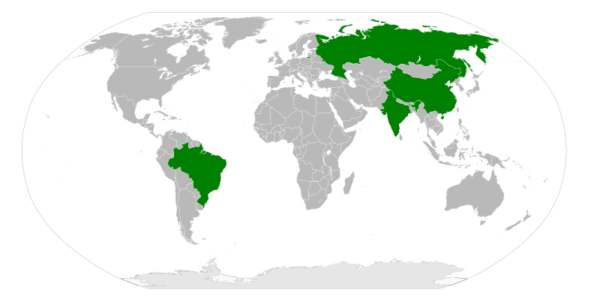
In recent years, the so-called BRIC nations—Brazil, Russia, India and China—have been the engines for world economic growth. Now, as growth in these countries is slowing down, the developed economies of Japan, Europe and the United States are picking up the slack.
That certainly sounds like big news—and good news for those “developed economies.” But the piece is curiously short of numbers to back up its sweeping claims.
We learn that “the gross domestic product of the 17-nation euro zone grew at an annualized rate of about 1.2 percent in the second quarter,” and that Brazil has gone from a 7.6 percent growth rate two years ago to a projected 2.3 percent rate this year—though the alert reader will notice that 2.3 percent for a year is better than 1.2 percent for a quarter.
Popper also reports that “analysts are expecting that growth in the United States will rise from less than 2 percent this year to nearly 3 percent next year”—even though GDP forecasts are notoriously inaccurate. We’re told that “in China, the 14.2 percent expansion seen before the peak in 2007 is not likely to be reached again, though the expected growth of 7.5 percent next year is still impressive.”
That is still impressive—and more than twice as big as “nearly 3 percent.” So how is the balance of growth tipping in a different direction? Popper explains that:
Because the developed economies still account for nearly 60 percent of the global economy, even a slower pace of growth can provide more economic activity than faster growth in the developing world.
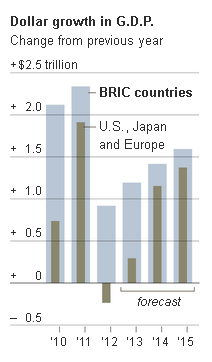
From the New York Times.
Oh, OK. So what is the overall growth of the developed world compared to the overall growth of the BRIC countries—you know, the comparison that is the subject of the whole article? Oddly, Popper doesn’t provide these crucial figures, but you can get a general sense of them from the above-mentioned accompanying chart.
And you begin to see why Popper doesn’t include numbers—because they completely contradict his thesis.
Three years ago, BRIC growth (in GDP dollars) totally outstripped that of the U.S., Europe and Japan—roughly $750 billion to more than $2 trillion. (I am eyeballing these numbers from the chart.) Two years ago, the developed world’s growth was closer, but still about half a trillion less. Last year, BRIC growth fell sharply, to a little less than $1 trillion—but developed growth collapsed, actually falling by maybe $200 billion.
This year, growth in the developed world is expected to be maybe $300 billion—again, far less than the more than $1 trillion projected for China and co.
Looking into the future—and again, projections of future GDP are essentially guesses—economists see the developed countries growing nearly but not quite as much as the major developing economies.
If you can work out how those numbers justify a story about “the balance of world economic growth…tipping in another direction”—well, your imaginative skills may be in demand at the New York Times.



I sometimes wonder why the slicksters who cleverized the term “BRIC” did not add the missing “K” for Korea. Here in Alabama at least, it is Kia and Hyundai that have contributed the most to any recovery that has been to be had here. Airbus will be destroying –er, I mean “developing” — land in the Mobile area for their newest expansion of empire, leveraging slave wages.
I guess I don’t know what the NYT or this idiot reporter is talking about, even after Jim has done such an excellent job of pointing out the flaws in the so-called “report.”
It helps if you regard the NYT as the voice of the “educated” ruling class. And that class fears the challenge of China;s economy (as well as the rest of BRIC. Not a day goes by without a China-bashing piece in the NYT.China
You have to be careful when comparing rates of growth. If one country has a GDP of 1000 units and increases that GDP by three percent, that comes to 30 units. If another country has a GDP of 100 units and increases by three percent, that is 3 units. The article may be right in pointing out that BRIC countries appear to be growing at rates equal to Europe and NA, but that growth needs to be looked at without using “percent increase.”
@lastmarx
I really doubt that the “educated ruling class” actually “fears the challenge of China’s economy” — in fact, I think they’re relatively unconcerned with the so-called “challenge”. China does provide some global competition in terms of oil and resource contracts in the developing world, but US and other major corporations are quite happy to use China as the world’s manufacturing facility due to its extremely low wages, horrible working conditions, massive reserve army of labour, and so on.
And really, why would the people at the top in the US fear China when its GDP per capita is nearly seven times lower than that of the US? It’s a very poor country that poses little threat, either now or at any point in the near future — except in a few strategic areas, like resource development, solar panels, etc., which the US could easily take care of, if it chose to.
Just to guess at what is the real function of all the economic fear-mongering around China, it seems to me that it’s quite similar to the “Soviet threat” or the “Beast of Baghdad” (Saddam) or the “rising threat of third-world technology”, or whatever US strategic planners come up with next. Basically, it’s very useful to have a Great Monster on the doorstep, with which you can beat the population into submission.
This has been the strategy of the powerful and wealthy for… well, forever, really: rule by stoking fear of some imagined threat, and get away with whatever you want to (e.g., funneling billions in “military spending” to high-tech industry) by screaming like madmen about the supposed threat. All the talk about China and its human rights violations, growing economy, blah blah blah — if the US really cared about these things, they’d stop doing business with China, period. But it’s far too profitable for US manufacturers, and far too convenient for US planners, so it remains a valued business partner and simultaneous Great Monster.
(But they’ll damn well “encircle” China militarily, just to be sure, as they’ve been doing for decades. Any threat, however minor, is completely intolerable to the totalitarian mind.)
Good lord people ever hear the term pie in the sky?We are printing money out of thin air to keep this balloon afloat people.We are borrowing the rest.And we are (get ready for this move that only an economic genius would make)spending money we don’t have, at a faster and faster rate.And we are worried about other countries??????
What’s with this obsessive focus on growth? Eternal growth is the philosophy of cancer. We need a government that recognizes that if we don’t start planning for negative growth, and managing our affairs to deal with it it, then it will happen anyway, and will be massively less pleasant than if we plan for it.
Every techno-fix only buries us deeper in the shit.
We’ll get a few more years of profligate waste of fossil fuels before they’re all gone, and for those few years we seem to be willing to trade whole aquifers, forests, wildlife, farmland…
Clothes hung out to dry in the sun? No help to the GDP. Clothes dried in a drier? Steel mills, iron mines, factories to build the drier, and coal mines or fracked natural gas or nuke plants to supply the electricity. Square miles converted to toxic sites, but hey, it pumps up the GDP.
Clarence…..This idea that progress equals destruction of the earth does not have to be true.And there is enough gas under our feet for hundreds of years.Plenty of time for a new world to emerge.
No difference….So we are finally back to the lefts same old shtick.Global warming(a total hoax with weak science, and strong political motivations)And the idea that we are destroying the earth…..Or surely will in the future if America ever gets off burning middle Eastern fuel…and instead burn the exact same amounts of OUR OWN FEUL!I don’t know why you think the American people are stupid enough to buy this malarky.We need to extricate ourselves from dependance on the middle east.Beside the massive economic possibilities,this is a win win.How about this quote “development of oil will soon leave this country a wasteland.That along with over forestation will leave this country bare and blackened .Air unfit to breath .Water unfit to drink .Crops dead and dying.Within 30 years will there even a good clean place left in this country to place ones feet.”Now you would probably agree with that.Problem is that was written in 1918!!!!!!!!!!So you are singing the same old song.This country is doing amazing work cleaning our environment.Our population is nearing zero growth rate or near about’s.We must all work to end pollution.But my guess is the 50,000 regulations on the books are plenty along those lines.No need to give this government ANY more power.Or any power to block development of our own natural resources(beyond the standard rules and regs)